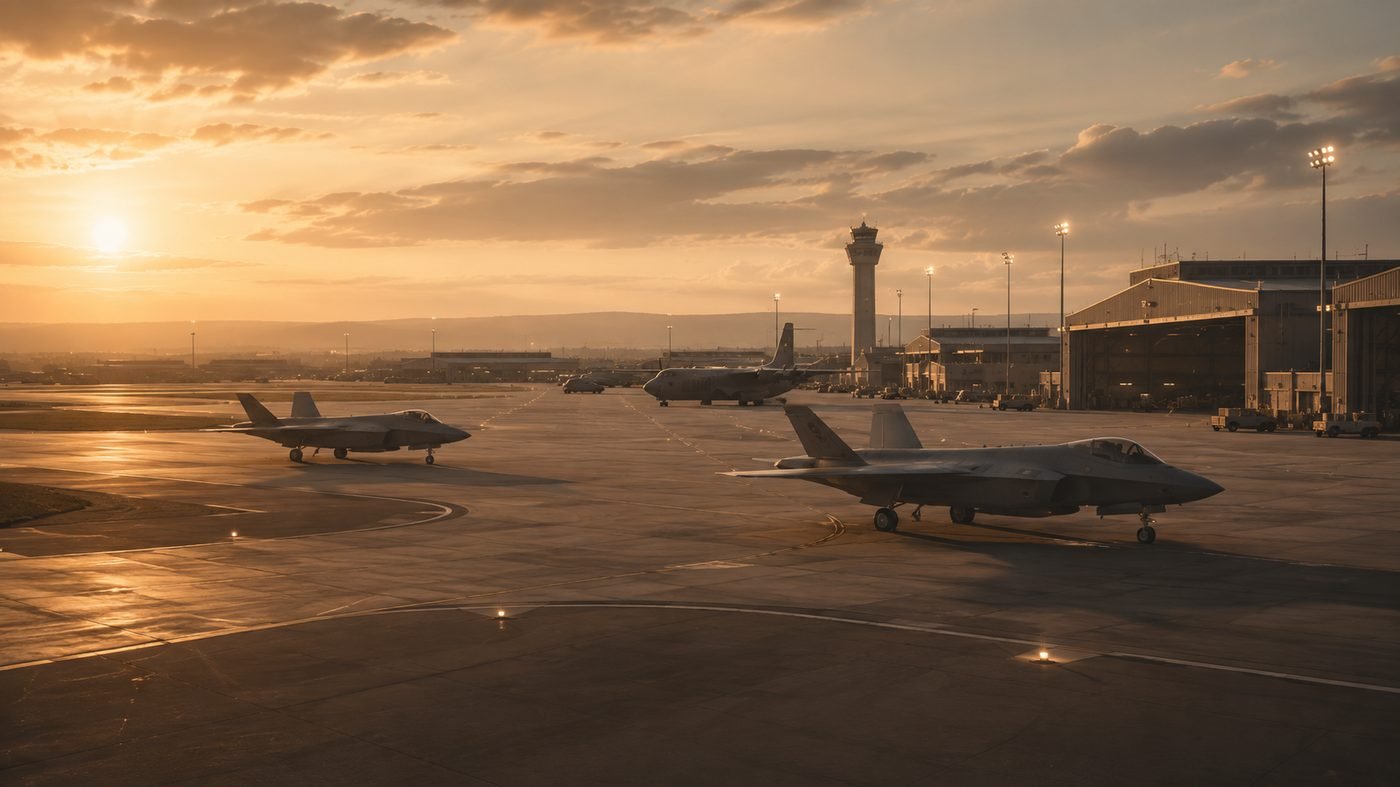
Training area containment
Define training areas on the map. Soteriia identifies the aircraft inside each area and alerts the controller the moment one of them leaves it.
Soteriia checks what the controller cleared against what the crew read back, and against where the aircraft actually goes. When they disagree, the controller gets an advisory.

Understands each clearance and readback on the frequency: callsign, runway, level, heading, route.
Checks the readback against the clearance, and both against where the aircraft actually goes on ADS-B and radar.
On a mismatch the controller gets an advisory. Soteriia never transmits; the controller decides.
The detail behind the product, one subject at a time.
Controllers and crews are highly trained. Under workload, radio noise and expectation bias, the ear still misses a share of errors, and research has measured how many.
37%
of hearback errors went undetected in tower local control
FAA research on tower controller-pilot communication under operational workload
40%
of readback errors went uncorrected in the approach environment
FAA research on TRACON controller-pilot voice communication
More than 700 pilot-deviation runway incursions in one year
Those three made the news. In the U.S. alone, the FAA recorded more than 700 pilot-deviation runway incursions in the most recent reporting year: cases where a crew proceeded without the clearance that had actually been issued, on the ground or in the air. That is exactly the mismatch Soteriia verifies in real time, before it becomes a statistic. FAA Runway Safety data, 2024
Speech recognition only gives you words. Soteriia works out what was cleared, what was accepted and what the aircraft is doing about it.
Extracts the operational intent of each transmission: callsign, runway, level, heading, route. Built for ICAO phraseology, accents and real radio quality.
Fuses that intent with live data from ADS-B, surface movement radar, radar and Mode S. A correct readback followed by the wrong movement is still caught.
Every exchange is logged and searchable, which cuts reconstruction time for safety review, compliance and investigation.
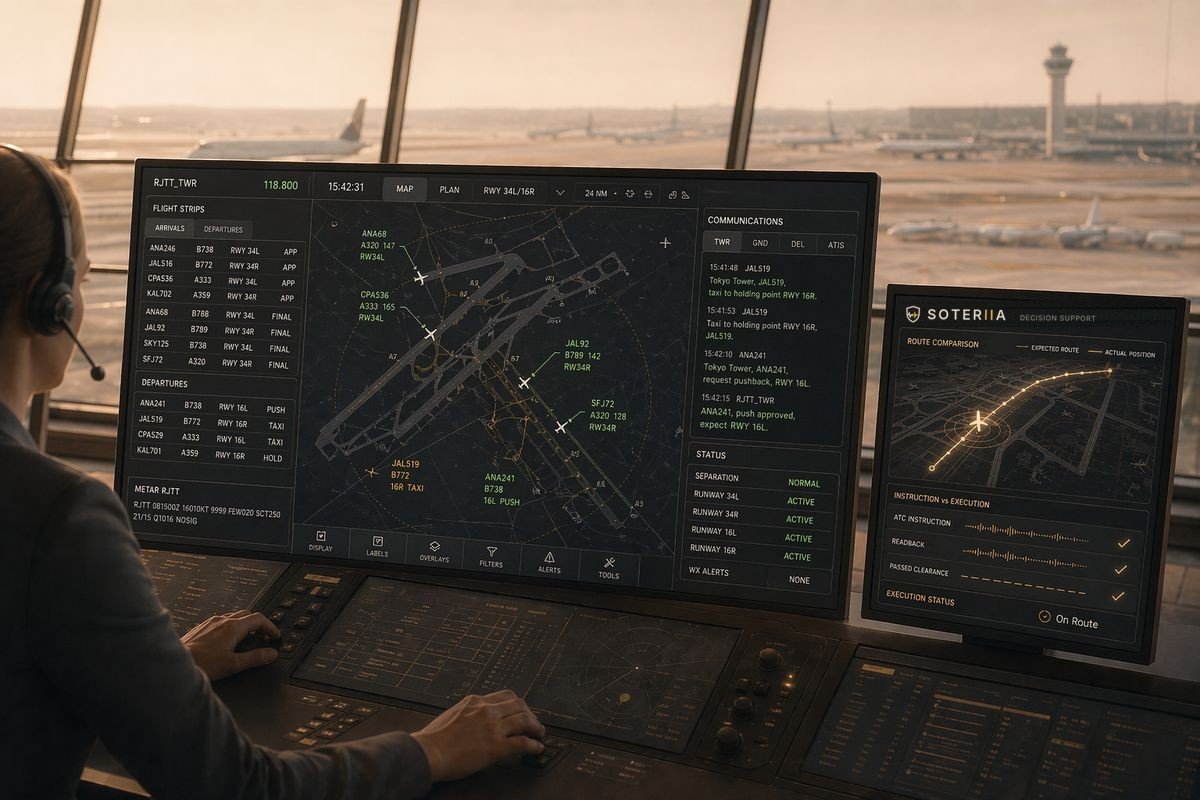
Soteriia listens and watches. It never transmits, never issues an instruction and never takes authority from the controller.
The value is not only detecting the error. The value is detecting it early enough to change the outcome.
Recordings tell you what was said, after the fact. Surveillance tells you where the aircraft is, not whether that matches its clearance. Soteriia is built for the moment before.
Clearance issued
Hold short runway 25
Wrong readback
Holding short runway 29
{{winText}}
{{endTitle}}
{{endText}}
Times are illustrative.
Five short simulations with radio audio and on-screen captions, grouped by what Soteriia checks. Turn the sound on.
{{fcur.title}} {{fcur.dur}}
The problem
{{fcur.prob}}
How Soteriia catches it
{{fcur.fix}}
{{g.name}}
These are examples only. Each operator defines its own limits, as many as it needs: speeds and descent rates by altitude, phase of flight or aircraft category, minimum and maximum altitudes, training areas, and cleared taxi routes. Soteriia monitors every aircraft against all of them at once.
Beyond the readback, Soteriia watches every aircraft against the boundaries and limits you define, and alerts the controller as soon as one is crossed.
Define training areas on the map. Soteriia identifies the aircraft inside each area and alerts the controller the moment one of them leaves it.
Enter the limits for each phase of flight: speed, rate of descent, minimum and maximum altitudes. Soteriia checks every aircraft in the defined area against them, using ADS-B, radar and Mode S data, and alerts the controller when a limit is exceeded.
Soteriia knows each arriving aircraft's approach category, A to D, and the maximum speed the operator has set for it on final. From 1.6 NM to touchdown it compares the live speed from ADS-B and radar with that limit, and alerts the controller if the aircraft is faster. A landing that is too fast can end in a runway excursion.
Categories by Vref, or 1.3 Vso where Vref is not specified, per FAA TERPS. Example limits are the category upper bound plus 20 kt; each operator sets its own. Callsign and values are illustrative.
Limits and areas are set by the operator. Live values shown are illustrative.
A second check on every clearance and readback at the busiest positions, when workload peaks.
Fewer runway and movement-area events, and auditable evidence of active risk monitoring.
One verification layer that scales from a single position to a network, with structured records for your SMS.
Military voice and data-link inputs, checked against radar, Mode S and platform telemetry.
$98.41
per aircraft block minute
Average U.S. passenger airline cost, 2025. Airlines for America. Every avoidable delay minute compounds across crew, fuel and schedule.
$10K+
per disrupted event
A misrouting, missed slot or go-around creates cascading recovery costs at congested airports.
$1.9M
average runway incident claim
Allianz Commercial analysis of 470 runway incident claims over five years, before disruption and reputational cost.
$100M+
hull exposure in one major runway accident
Catastrophic events can exceed half a billion dollars in total losses.
A continuous, documented verification layer strengthens an airport's demonstrable risk posture, supporting conversations with insurers, regulators and safety auditors from a position of evidence rather than assertion.
Designed around position-based licensing, Soteriia can start with selected ATC positions and expand toward broader tower, airport or ANSP-level deployment, supporting recurring revenue while allowing customers to validate before scaling.
Underwriters price operational risk. A single runway loss can weigh on renewal terms for years, and communication mismatches sit upstream of many of those events.
Aviation insurance markets have hardened after consecutive loss-making years. Airport and tower operators absorb the result: higher premiums, tighter capacity and closer underwriter scrutiny of operational risk.
8–12%
annual premium hardening
Observed across commercial airport liability accounts in recent renewal cycles, as insurers rebuild premium adequacy after major losses.
10–25%
premium increase after a single claim
One loss can raise premiums for years. Multiple claims can restrict carrier options entirely, forcing operators into a narrower, more expensive market.
$1.9M
average runway incident claim
Allianz Commercial analysis of 470 runway incident claims over five years, before liability, disruption and reputational cost.
Lower risk is something you can show, and price
Positions running Soteriia carry less communication risk. That lower risk, backed by a documented record, is a concrete argument for better terms at renewal.
Fewer claims leave more margin, even after a lower premium
When claims fall by more than the premium discount, the insurer keeps more. That gives underwriters a clear reason to reward verified communication monitoring, and to require it.
Premiums are set by insurers and depend on each operator's full risk profile. Soteriia strengthens the risk posture those conversations are built on.
Each stage is cleared before the next. Controllers see nothing until your safety team is satisfied.
Passive taps on existing voice and surveillance feeds. No change to radio hardware or ATC systems.
Silent learning of local acoustics, phraseology, accents and sector terminology.
Validation in real operations. Your safety team reviews every alert while controller workflow stays untouched.
Live advisories on a dedicated display or an existing tower dashboard.
Licensed by position. Start with the positions that carry the most risk, prove the result in shadow mode, then extend to the whole tower, the airport or your ANSP network.
Deployment follows each operator's confidentiality and infrastructure rules, from a single tower to a closed military network.
Developed with the support of the Civil Aviation Authority of Israel (CAAI), and in active engagement with additional aviation regulators.
Phraseology is compressed, radio audio is noisy, callsigns get confused and clearances depend on context. Getting the words right does not prove the aircraft is doing the right thing.
Soteriia is not a generic AI product looking for an aviation use case. It is built by aviation professionals with direct experience in airline operations, flight safety, training, audits, aircraft induction, ATC/ATM environments and operational risk.
Civil aviation is the first market: structured phraseology, high safety pressure, existing surveillance data and measurable operational risk. Adjacent domains are strategic upside, not the first commercial target.
The same architecture with a different communications layer. The core engine is built to ingest military voice and data-link communication and cross-reference it against tactical and operational position sources, including radar, ADS-B and Mode S where available, and platform-reported telemetry. Military tower and ramp operations get the same independent verification layer as civil ATC.
Those are the conditions for any tool a controller will keep switched on. The engine is built around them and calibrated to each site.
Performance is being validated through internal testing and staged operational trials with regulatory and airport partners. Results are shared in briefings and will be published as validation progresses.
We walk your team through the architecture, prototype benchmarks and a deployment path for your tower, airport or ANSP.